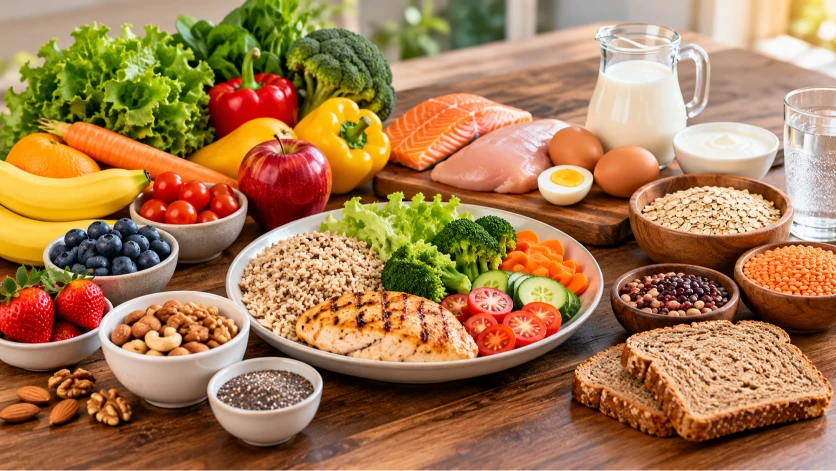
A balanced diet is an eating pattern that delivers carbohydrates, proteins, fats, vitamins, minerals and water in the correct quantities and proportions your body needs, built from a wide variety of foods across all the main food groups.
That definition sounds tidy, yet many people picture something else entirely: a plate rescued by a handful of blueberries after a double cheeseburger. Balance does not work as a trade. A balanced diet is a steady pattern of whole foods in healthy proportions across days and weeks, which is why no single meal, and no shopping list of superfoods, can carry the job alone.
The payoff of a balanced diet is broad. Getting the mix right supports growth and development in children, keeps energy levels steady in adults, and underpins optimal physical and mental functioning at every age. Over decades, the same pattern is the most practical everyday tool for disease prevention, lowering exposure to chronic diseases that build quietly.
Plant foods earn their place for more than their calories. Fruits, vegetables and grains carry dietary fiber, antioxidants and other bioactive phytochemicals, and their different colors signal different nutrient mixes. The sections below break the balanced diet down food group by food group, with the numbers that matter, and you can explore more practical healthy living guides as you shape your own routine.
What Does a Balanced Diet Actually Mean?
A balanced diet actually means a sustainable eating pattern that draws from all five core groups (vegetables, fruit, grains, protein foods and dairy) in amounts matched to your own physiological requirements.
The word “sustainable” does the heavy lifting. A well-balanced diet favours variety over restriction, supplying macronutrients for fuel and micronutrients for the chemistry of metabolic health, with a small reserve held for short-term replenishment of nutrients. Built that way, everyday eating becomes an evidence-based framework rather than a diet you go on and off.
Self-assessment is where a balanced diet usually slips. A 2022 study found that about 85% of people surveyed believed their diets were healthier than they really were. I see the same gap whenever someone lists their meals from memory: the treats shrink and the vegetables grow.
The reward spans the whole life-course. Repeated mindful choices and nutrient-dense foods help protect against malnutrition in all its forms and against noncommunicable diseases, support a healthy body weight, and feed mental clarity and metabolic resilience, the traits of people who live longer inside a healthy lifestyle. This advice suits the general population; anyone with special dietary needs should get a plan from a registered dietitian.
Why Does a Balanced Diet Matter for Your Health?
A balanced diet matters because unhealthy eating is a major risk factor for disease and disability, while a well-built diet protects health from breastfeeding in infancy through old age.
History explains the urgency. Shifts in food systems, rapid urbanization and changing lifestyles have pushed dietary patterns toward highly processed foods heavy in unhealthy fats, free sugars and salt, while fruit, vegetables and fibre fall short. The modern plate drifted; nobody really chose it.
Timing matters as much as content. Dietary behaviours formed in childhood and adolescence tend to follow people into adulthood, so habits set at the family table carry consequences for decades. That makes children’s meals an investment rather than a daily battle.
A balanced diet still bends to real life. The exact shape of a balanced diet changes with cultural context, locally-available foods and dietary customs, yet it always rests on four core principles: adequacy, balance, moderation and diversity. Balance here includes a sensible split across the three primary sources of energy, and a diet only counts as healthy if it is also safe, meaning free from microbial and chemical contaminants. Leaning on minimally processed and unprocessed foods meets all of those conditions at once.
What Are the Main Components of a Balanced Diet?
The main components of a balanced diet are the three energy-giving macronutrients plus vitamins, minerals, fibre and water, and the small-print nutrients are the ones most often missing.
Micronutrients prove the point. There are about 30 essential ones, 13 vitamins and 16 minerals such as iodine, and shortfalls show up as anaemia, scurvy, cognitive impairment or neural tube defects. Globally, more than half of children under five and over two-thirds of non-pregnant women of reproductive age lack at least one key micronutrient. Where deficiency rates reach 20% or higher, countries add nutrients through food fortification, such as folic acid in flour or iodised salt.
Fibre is the component most adults underrate. Anyone older than 10 should aim for at least 25 grams of naturally occurring dietary fibre a day, while children aged 2–5 and 6–9 need at least 15 or 21 grams respectively. Fibre creates a lasting feeling of fullness and keeps the digestive system working smoothly.
Hydration completes the set. Guidance ranges from 6 to 8 glasses of fluid a day to 7–8 glasses, and tap and bottled water, tea, coffee, herbal teas and unflavoured sparkling water all count. Fruit juice counts too, though its sugar makes it the drink to keep small.
How Many Fruits and Vegetables Should You Eat Each Day?
Adults should eat a minimum of five portions of fruit and vegetables every day, so that produce fills roughly half of each plate.
The sorting rule trips people up. Potatoes, corn and peas feel like vegetables, but their nutrients sit closer to starchy foods, so they belong with the grain portion rather than the produce half. Even so, a jacket potato eaten with the skins on delivers useful fibre and vitamins, which is a good reason not to peel.
Legumes play both sides of the plate. Pulses such as lentils and chickpeas count toward daily produce portions while adding protein and slow-burning carbohydrate. A pan of bulgur or quinoa tossed with roasted vegetables is my favourite way to make vegetables the main event rather than a garnish.
Produce also partners with the body’s primary energy source, carbohydrate, which should supply around 45–75% of daily energy in unrefined forms. Pairing vegetables with wholegrain or wholemeal bread, brown rice, wholewheat pasta, oats, rye, barley, buckwheat, millet or unprocessed maize keeps meals low-GI, aids digestion and supports muscle regeneration.
The milling step explains why grain choice changes the value of a vegetable meal. Wheat milled into whole-wheat flour keeps its fibre, while refined flour and other refined grains lose much of it, which is why higher-fibre versions win.
Which Grains and Starchy Carbohydrates Belong in a Balanced Diet?
Whole, fibre-rich grains and other starchy carbohydrates belong in a balanced diet as the base of every meal, making up just over a third of everything you eat.
Grain choice works best when it is planned alongside vegetables. Starchy vegetables such as corn sit in the grain quarter of the plate, while non-starchy produce like green leafy vegetables, spinach, kale and broccoli should cover half your plate. A side salad next to a whole-grain bowl keeps both halves honest.
Quantity targets anchor the produce half around the grains: aim for at least 5 portions a day, the familiar 5 A Day, which equals about 400 grams for anyone over 10 and 250 or 350 grams for children aged 2–5 and 6–9. One portion is 80g of fresh, canned or frozen produce, 30g of dried fruit, or 3 heaped tablespoons of vegetables.
Drinks count only once, however much you pour. A 150ml glass of juiced fruit or a smoothie gives a single portion a day. Whole citrus and berries are better value, and buying seasonal produce keeps potassium-rich fruit and vegetables affordable through the year.
What Are the Best Protein Sources for a Balanced Diet?
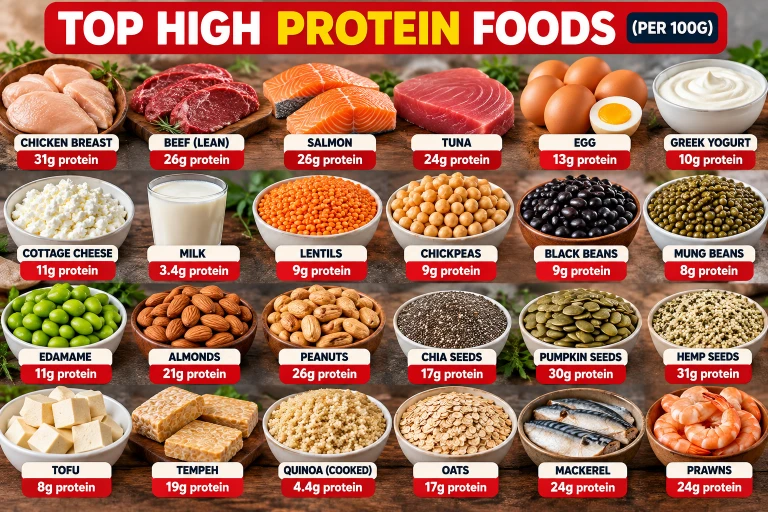
The best protein sources for a balanced diet are a varied mix of lean animal and plant foods, including fish, eggs, beans, nuts and lower-fat dairy.
Dairy is an underrated protein option. Milk, yoghurt and cheese supply protein along with calcium and often vitamin D, the pair behind strong bones. Choosing semi-skimmed, 1% fat or skimmed milk, plus cottage cheese, trims saturated fat without losing protein. A serving looks like 250ml milk, 200g yoghurt or 40g hard cheese; in cup terms the general target is 3 cups of dairy a day, where 1 1/2 ounces of hard cheese or 1/3 cup shredded cheese counts as one.
Plant-forward eaters have plenty of protein choice. Anyone following a vegan diet or who is lactose intolerant can use tofu set with calcium sulfate, which doubles as a protein and calcium source, along with almonds, cashews and flaxseeds. Milk alternatives such as soya drinks or those made from oats or coconut fill the calcium gap best when unsweetened and fortified.
Fish earns its place for more than protein alone. Canned sardines deliver protein and calcium in one cheap tin, while a glass of calcium-fortified orange juice covers the mineral, though not the protein, when dairy is off the menu.
How Much Dairy or Dairy Alternative Do You Need?
Most adults need about two and a half to three servings of dairy or fortified dairy alternatives a day, and that amount works best as part of a wider protein plan.
Dairy shares the protein workload. Adults generally meet their needs when protein supplies 10–15% of daily energy, roughly 50–75 grams on a 2,000-calorie day, and a pot of yoghurt chips away at that total. Protein builds structures such as muscle mass and functional molecules like hormones and enzymes, helps the body grow and repair, and speeds wound healing. Pushing far beyond need adds metabolic strain, particularly on the kidneys.
The rest of the protein quarter should rotate. Chicken breast, skinless poultry and lean cuts of meat supply iron, zinc and vitamin B12, while tofu, tempeh and unsalted nuts are strong plant-based sources. Aim for 2 portions of fish a week, one of them oily fish such as salmon.
Red meat needs a ceiling next to the dairy. Keep red meat to 3 portions a week, with guidance putting the cooked amount at 350 to 500g, and go easy on processed meat like bacon and sausages, which is linked to a higher risk of bowel cancer.
Which Fats and Oils Are Healthy, and How Much Do You Need?
Healthy fats are the unsaturated fats from plant oils, nuts, seeds and fish, eaten in modest quantities, while the fats worth cutting usually arrive packaged with sugar and salt.
That packaging is the real problem with unhealthy fat. Donuts, pizza, chips and ice cream are ultra-processed discretionary foods that stack fat on top of free sugars and sodium, so they behave like empty calories: plenty of energy, little nutrition. Soft drinks and energy drinks add the sugar without the fat, and frequent sugar raises the risk of obesity and tooth decay, while excess added sugar is linked to insulin resistance.
Sugar has clear numeric limits that sit alongside fat limits. Keep free sugars to less than 10% of daily energy, about 50 g or 12 level teaspoons on 2,000 calories, with 5% or less offering extra benefit. Free sugars include honey and syrups, and the reduction should happen without non-sugar sweeteners such as aspartame or stevia.
Salt follows the same logic. Adults should keep salt to less than 5 grams a day and aim for potassium of at least 90 mmol/day (3510 mg). Lower-sodium salt substitutes help, except for people at risk of hyperkalaemia. None of this rules out an occasional indulgence, whereas excessive alcohol brings no nutritional upside at all.
Where Do Vitamins, Minerals and Fibre Come From in a Balanced Diet?
Vitamins, minerals and fibre come from eating across all five food groups every day, because each food group specialises in a different set of nutrients.
National food guides package that idea in different ways. The USDA retired the food pyramid in 2011 and replaced it with MyPlate, the UK uses the Eatwell Guide, and the Australian Dietary Guidelines from the NHMRC set daily serves. The free MyPlate Plan tool adjusts amounts for your height, weight and activity level.
| Food group | Main vitamins, minerals and fibre | Adult daily serves |
| Vegetables and legumes | Fibre, folate, potassium, magnesium | 5–6 serves |
| Fruit | Vitamin C, potassium, folate, fibre | 2 serves |
| Grain (cereal) foods, mostly wholegrain | B vitamins, iron, zinc, fibre | 3–6 serves |
| Lean meats, poultry, fish, eggs, nuts, seeds, legumes | Protein, iron, zinc, omega-3 fats | 2–3 serves |
| Milk, yoghurt, cheese and dairy alternatives | Calcium, protein | 2.5 serves |
These serve counts are population averages, and some conditions override them. People managing Celiac disease, gastroparesis or kidney disease need an eating plan built for that condition rather than general food-group targets.
What Is the Ideal Ratio of Carbs, Protein and Fat?
There is no single ideal ratio of carbs, protein and fat, but most guidance puts carbohydrates at roughly half of daily energy or a little more, fat at about a fifth to a third, and protein filling the remainder.
The quickest way to see why the ranges are wide is to study a diet that flips them. A ketogenic plan is very low-carbohydrate and high-fat: carbohydrate drops to <5–10% of energy, around 20–50g/day, fat climbs to 60–75%, and protein sits at 15–30%, pushing the body into ketosis. Keto has a recognised role in epilepsy and belongs under medical supervision; adherence tends to drop over time, and cutting grains raises concerns about nutrients like thiamine.
The Mediterranean diet, drawn from countries around the Mediterranean Sea, shows the opposite route: ordinary ratios, better ingredients. Olive oil, legumes, seafood, red meat only a few times per month, and red wine traditionally taken in moderation with meals give it strong long-term evidence for cardiovascular health and protection against cognitive decline. For anyone with a family history of heart disease, I find that quality-first framing more useful than chasing exact percentages.
Which Foods Should You Limit on a Balanced Diet?

The foods to limit on a balanced diet are those high in saturated or trans fat, added sugar and salt, together with refined carbohydrates and heavy drinking.
Fat deserves the most nuance, because some fat is essential. Fat supports cell health, hormone synthesis and nutrient absorption, and two fatty acids, linoleic acid and α-linolenic acid, can only come from food. Adults should therefore get a minimum of 15% of energy from fat while keeping the total at 30% or less. Every fat is high in energy, so even good ones belong in small amounts.
The type of fat decides what to cut back:
- Saturated fat: found in butter, ghee, lard, cream, cheese and palm and coconut oil; keep it to no more than 10% of energy.
- Trans fat: both industrially-produced (baked goods, fried snacks, some spreads) and ruminant (from cattle, sheep and goats); keep it to no more than 1% and avoid the industrial kind entirely.
- Unsaturated fats: polyunsaturated and monounsaturated oils such as sunflower, canola, olive oil and extra virgin olive oil, plus avocado; these are the replacements.
Cooking technique cuts harmful fat without changing the menu. Steaming or boiling instead of frying, and cooking with unsaturated oils and spreads in place of butter, can help lower cholesterol.
Can a Balanced Diet Help You Lose Weight?
Yes, a balanced diet supports weight loss when it creates a modest, steady energy shortfall while still covering every nutrient your body needs.
The common weight-loss traps are behavioural rather than nutritional. Low-carb messaging has made over-restricting carbohydrates feel virtuous, yet whole grains, legumes and fruit are among the most protective foods available. Swinging to too much protein at their expense drags fibre down, which shows up as constipation, elevated cholesterol and poorer gut health.
Drinks and weekends quietly undo the work. Liquid calories from sports drinks, juices and alcohol skip the fullness signals that food triggers, and weekend excess means five careful days plus two loose ones is not a 70% healthy week, because the impact on blood glucose and calorie intake is disproportionate. Most Australians already under-eat vegetables, so a takeaway weekend widens an existing gap.
Eating speed is the weight-loss habit I would fix first. Fullness signals need about 15–20 minutes to reach the brain, so putting down utensils between bites and eating away from screens genuinely helps. Beyond that, personalisation beats generic online meal plans that ignore your food intolerances, budget and cooking ability, and no capsule of supplements can copy the synergistic effect of nutrients in whole food.
What Does a Balanced Diet Look Like for Children?
A balanced diet for children includes foods from all five groups every day, served as regular meals and snacks that suit the child’s age and appetite.
Familiar dishes do the job better than special kids’ food. A 7-day rotation might open with oatmeal, overnight oats topped with chia seeds, scrambled eggs, poha with raita, upma, idli with sambar, or a protein-rich besan cheela with curd. Each breakfast pairs a grain with protein or dairy, which keeps a growing child full until lunch.
Lunch and dinner for children can follow the family table. Moong dal or dahl with chapati, dalia pulao, palak paneer, matar mushroom curry, fish curry, or baked salmon with sweet potato and broccolini each cover several food groups at once. A wholegrain wrap with hummus travels well in a lunchbox, and weekend shakshuka with toast suits every age.
Snacks are where a child’s balance usually slips. Roasted lotus seeds, whole-grain crackers, Greek yoghurt or apple slices with almond butter beat packaged treats. Parents model drinking habits too: adult plans often set at least 2 litres of water a day, and family mealtimes are where children copy what they see.
How Should a Balanced Diet Chart Change From Infancy Onward?
A balanced diet chart changes in stages, starting with breast milk alone and moving step by step toward the same varied plate the rest of the family eats.
The early chart follows a fixed sequence:
- First 6 months: infants are breastfed exclusively.
- From 6 months: breast milk is complemented with safe, nutrient-dense complementary foods, with no added salt or sugar.
- 6–23 months: a diverse diet including meat, fish or eggs plus fruit and vegetables, with starchy staple foods minimised and sweet beverages avoided.
- To 2 years of age and beyond: breastfeeding continues alongside family foods.
Plate-proportion guides do not apply under the age of 2, because babies have different nutritional needs. For school-aged children (5–12 years), the chart becomes a normal day of meals. Iron deficiency is a common childhood shortfall tied to weaker cognitive development and school performance, and DHA from oily fish and eggs supports the growing brain. The same pattern builds strong bones and teeth, lowers the risk of childhood obesity, and supports emotional development and steady mood and behaviour.
How food is offered matters as much as the chart. The division of responsibility (parents choose what is served, children decide whether and how much to eat) works better than pressure to clean their plate, which can entrench picky eating, and banning treats can feed disordered eating later. Hidden vegetables are a useful bridge, not a substitute for visible ones.
How Can You Stick to a Balanced Diet Every Day?
You can stick to a balanced diet every day by shaping your surroundings so the healthy option is the easy option, then repeating a few simple routines.
Public health planners call this choice architecture: adjusting how food options are presented, placed and priced. The same experiment works at home, where fruit on the counter changes the default snack without any willpower. Schools and the workplace are adopting the idea through standards for healthier food on site.
Labels are the second tool for sticking to a balanced diet. Nutrition labelling aligned with Codex Alimentarius Commission guidelines and simple front-of-pack labelling let you compare sugar, salt and fat in seconds. Policies such as taxes on less healthy products, subsidies for growers of fresh produce and incentives for product reformulation aim to nudge the food supply, while food marketing often pulls the other way.
Bigger forces explain why willpower alone fails. Income, food prices, affordability, cultural traditions and even climate change shape every shopping basket, so lasting change needs multiple sectors working together. Since a global diet strategy launched in 2004, more than 15 guidelines have appeared in a decade, more than 3100 food policies are tracked, and the REPLACE action package against industrial trans fat already protects over 50% of the global population. Personally, building culinary skills, using dietary counselling in primary health-care, and joining support like the Baby-friendly Hospital Initiative as a new parent turn that big picture into daily habit.
What Are the Core Principles Behind Any Healthy Diet?
Every healthy diet rests on four principles, adequacy, balance, moderation and diversity, and each principle protects a different part of your health.
Adequacy means meeting nutrient needs without overshooting them, and the payoff shows up in places people rarely link to food. Omega-3 fatty acids, magnesium, B vitamins and zinc are essential for brain health, which is why nutritional psychiatry connects diet quality with mood, anxiety, depression and cognitive function. Adequate calcium, vitamin D and protein protect bone density, which in older adults lowers falls risk.
Balance is about energy in versus energy out. A balanced intake supports a healthy weight by steadying appetite hormones and preventing the blood sugar swings that drive overeating, and it helps the immune system fend off infections. Adults gain sharper concentration and memory, while children show better academic performance.
Moderation and diversity play the long game. The Australian Institute of Health and Welfare links poor diet to a large share of the national burden of disease, including type 2 diabetes, cardiovascular disease and certain cancers, so limiting harmful foods lowers chronic disease risk, high blood pressure and stroke. Diversity feeds the gut microbiome, improving gut health through the gut-brain axis, and shared meals build interpersonal connections that help people handle stress.
What Should a Balanced Diet Look Like During Pregnancy?
A balanced diet during pregnancy keeps all five food groups, adds a few targeted nutrients and only a small amount of extra energy, and watches blood sugar closely.
Blood sugar deserves attention because gestational diabetes can develop during pregnancy, and women already living with type 1 diabetes face tighter control. The core tactic is carbohydrate quality: slow-digesting choices produce a gentler rise in blood glucose levels than high-GI foods such as white bread or jasmine rice. Learning to distribute carbohydrates evenly across meals and snacks avoids the glucose spikes that follow one heavy, starchy meal.
A practical pregnancy plate starts with vegetables. Half the plate goes to options like capsicum and zucchini, a quarter to lean protein and a quarter to slow carbohydrate, finished with 1 tsp of olive oil or ¼ avocado. Protein and vegetables add satiety between meals, and the pattern stays heart-healthy long after the birth.
Women with diabetes before or during pregnancy should not manage meals alone. Endocrinologists, diabetes educators and dietitians can match meals to the medication regimen and personal glucose targets, and steady food choices support insulin sensitivity alongside medical care.
How Should People With Diabetes Approach a Balanced Diet?
People with diabetes do best on a balanced diet that keeps carbohydrates but favours slow-digesting ones, pairs them with protein and vegetables, and spreads them evenly through the day.
That diabetes framework matters most at turning points, and planning a pregnancy is the biggest one for women with diabetes, because nutrient needs rise exactly when glucose control matters most for foetal development. Folate comes first: a 400–500mcg folic acid supplement daily before conception and through the first 12 weeks. Iodine at 150mcg daily is recommended for pregnant and lactating women.
Iron needs climb to support the placenta and the expanding maternal blood volume, and pairing iron-rich foods with vitamin C improves absorption. Energy needs rise far less than the eating for two myth suggests, about 1,400kJ extra per day in the third trimester, which helps anyone managing blood glucose.
Food safety rules sit on top of glucose rules for women with diabetes who are expecting. Skip raw or undercooked meat, eggs and seafood because of listeria and salmonella, avoid high-mercury fish like swordfish and marlin, and leave out unpasteurised dairy, soft cheeses, and deli meats or pâté unless thoroughly heated. With alcohol, there is no safe level during pregnancy.
What Are the Most Common Balanced Diet Mistakes?
The most common balanced diet mistakes are eating too few vegetables, fearing whole carbohydrates, drinking hidden calories and treating weight loss as a crash project instead of a steady habit.
The crash-project mindset is the costliest balanced diet mistake. A starvation diet or full meal replacement plan can drop weight fast, but fat loss that lasts comes from a small, consistent energy deficit that protects lean muscle. Protein helps because protein is the most satiating macronutrient and has a higher thermic effect; a common weight-loss target is 1.2–1.6g of protein per kilogram of body weight a day.
Carbohydrates get cut when they should be swapped. Foods with a low glycaemic index, like oats, legumes and basmati rice, keep energy steady. Meanwhile liquid kilojoules from juices, alcohol and flavoured coffees slip past attention; green tea, coconut water or warm water with lemon are easier swaps than giving up drinks altogether.
Skipping meals is the final common mistake. Three structured meals, simple high-protein starts such as eggs or sprouts, and sensible portion control beat grazing or fasting until dinner. If you are unsure whether you are overweight, a BMI calculator is a starting point, and free 12-week diet and exercise plans exist to guide sustainable weight loss.
How Does a Balanced Diet Compare With Keto and Mediterranean Diets?
A balanced diet sits between keto and the Mediterranean pattern: a balanced diet keeps every food group in moderate ranges, while keto slashes carbohydrates and the Mediterranean approach keeps similar ratios but leans on olive oil, fish and legumes.
| Feature | Balanced diet | Keto diet | Mediterranean diet |
| Carbohydrates | 45–65% of energy | A very small share | Moderate, mostly whole grains and legumes |
| Fat | 20–35% of energy | The main fuel source | Moderate, led by extra virgin olive oil |
| Protein | 15–25% of energy | Moderate | Fish, seafood and legumes first |
| Food variety | All groups included | Grains, legumes and most fruit restricted | High |
| Best suited to | Most people at every life stage | Specific conditions, with supervision | Heart and brain protection |
Published splits for a balanced plate vary slightly, which is reassuring rather than confusing. One reference suggests 50–60% carbohydrate, 15–20% protein and 20–30% fat as an ideal nutrient distribution; another uses 60–70%, 10–12% and 20–25%, and a wider protein band of 10–35% also appears. All of them describe the same basic shape.
Total amount matters as much as the split. Energy intake should match energy expenditure, whether you count calories or kilojoules. The average person needs about 2000 calories a day, but age, gender and physical activity level move that number: men usually need more than women, and active people more than sedentary ones. Daily needs run from 1,000–1,400 calories for sedentary children aged 2–8 to 2,800–3,200 for active males aged 14–30, with 1,600–2,400 for sedentary adults over 30.
What Can Families, Schools and Governments Do to Promote Healthy Eating?
Healthy eating is promoted most effectively when governments and schools make nutritious food affordable and visible, and when households turn that support into simple, repeatable routines.
At home, routine beats motivation. Don’t skip meals, since skipping lowers your metabolic rate and sets up overeating later; a rhythm of 3 main meals and 2 snacks works for many people, and the advice to never skip breakfast still holds. Keep healthy snacks in reach, eat plenty of raw foods such as salads and fruit, aim for five servings of produce, and stop when you feel full.
Kitchen technique cuts fat quietly at home. Trim visible fat and remove chicken skin before cooking, use a cooking oil spray, simmer in vegetable stock instead of oil, and thicken sauces with cornstarch or evaporated low-fat soy milk instead of cream. In vegetarian homes, pairing cereals and pulses at a grain-to-pulse protein ratio of at least 4:1 improves protein quality.
Planning makes the rest of healthy eating possible. Plan your meals weekly, batch cook grains and proteins, keep meals that take 20–30 minutes, store cut vegetables at eye level, and eat together as often as you can. Carry a packed lunch, eat out once a week at most, limit stimulants like caffeine, follow the 80/20 principle rather than perfection, notice emotional eating, and try the Healthy Choices quiz for personalised pointers.
Frequently Asked Questions (FAQs)
What Is the Simple Meaning of a Balanced Diet?
The simple meaning of a balanced diet is eating the right mix of foods from every main food group so your body gets the energy and nutrients it needs. That mix covers vegetables, fruit, grains, dairy, and protein foods such as fish, eggs, nuts, seeds and legumes. Each country’s dietary framework, including the version used in Australia, words it slightly differently. The core idea stays the same everywhere.
What Are the Five Food Groups?
The five food groups are vegetables and legumes, fruit, grain foods, protein foods, and dairy or dairy alternatives. Eating the right amounts from each group is the simple meaning of balance. A steady eating pattern built on all five helps the body function well and helps prevent disease. No group can stand in for another, because each supplies different nutrients.
What Does a Balanced Diet Look Like on a Plate?
A balanced diet on a plate looks like half non-starchy vegetables, a quarter lean protein and a quarter whole grains, with a little olive oil or avocado and some dairy on the side. That layout gives a steady supply of fuel throughout the day. Protein and fibre slow digestion, which helps stabilise blood glucose, manage hunger and prevent energy crashes. Stable fuel also supports sharper cognitive performance at work or school.
Why Are Balanced Meals Important?
Balanced meals are important because each balanced meal delivers carbohydrate, protein, fat and micronutrients together instead of leaving gaps to fix later. The Healthy Plate model makes that automatic. Vegetables take half the plate, a lean protein source takes one quarter, and a wholegrain carbohydrate takes the rest. A little healthy fat and a serve of dairy complete the meal.
Is a Balanced Diet Good for Fat Loss?
Yes, a balanced diet is good for fat loss because a balanced diet trims energy intake without stripping out nutrients or muscle-protecting protein. Meals built on frozen vegetables, canned and dried legumes and tinned fish such as tuna stay high in volume and protein. These affordable staples are also inexpensive, so a plan tailored to your budget is realistic. Seasonal fruit covers dessert.
How Can You Eat a Balanced Diet on a Budget?
You can eat a balanced diet on a budget by building meals around cheap, nourishing staples such as oats, eggs, legumes, frozen produce and brown rice. An evidence-based approach usually costs less than extreme diets that rely on special products. Budget-friendly balanced meals also avoid the nutrient deficiencies that crash plans cause. If weight loss is a goal, a modest calorie deficit built from these staples preserves muscle and is a sustainable approach.
What Are the Main Benefits of Eating a Balanced Diet?
The main benefits of eating a balanced diet are a reduced risk of type 2 diabetes, heart disease and some cancers, plus easier weight control and better day-to-day wellbeing. Benefits also include improved mood, better gut health and sustained energy levels. Adequate protein, calcium and vitamin D build stronger bones and muscles. A nutrient-rich mix supports improved immune function as well.
References
